Introducing Sume Avatar 1.0
Sume Avatar 1.0 is a multi-agent orchestration system as a single avatar model.
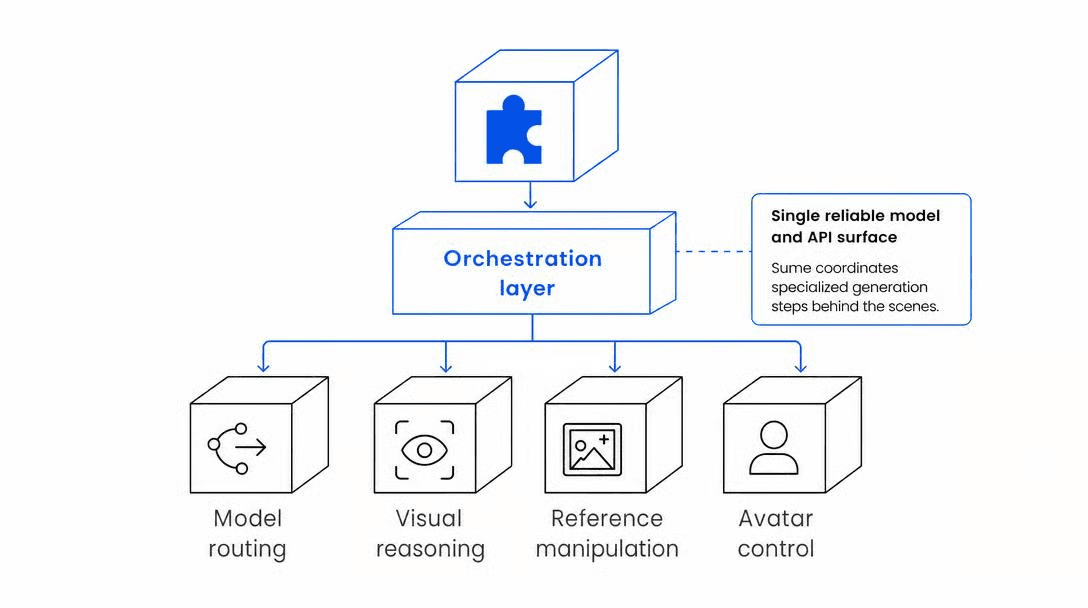
Today we're releasing Sume Avatar 1.0: A multi-agent orchestration system as a single avatar model. Avatar 1.0 is designed for frontier avatar-video performance while generating up to 60 seconds of consistent avatar videos.
Orchestration Is All You Need : Why Frontier Video Generation Is About Orchestration, Not Scale
Progress in video generation has thus far been driven by scaling individual video models. However, achieving frontier-level performance requires the composition of multiple specialized models—spanning image, audio, and scene understanding. Since the video modality occupies a substantially higher-dimensional space than text, each foundation model has its own strengths and best use cases.
Sume's central hypothesis is that this specialization is not a transient artifact of the current model generation but a persistent property of the field: foundation models will continue to diverge along distinct capability frontiers. It follows that optimal performance is attainable only through the principled composition of heterogeneous, independently-developed specialized models.
Critically, this is not solely a performance question but an adoption one. The capability to elicit production-grade output by hopping between multiple foundation models is gated behind expert-level prompting knowledge. Non-expert users fail to reach the production frontier. And the failure is misattributed to the user rather than to the absence of an abstraction layer.
An orchestration model resolves both problems simultaneously. Regardless of the user's input prompt, the orchestration layer maps it onto the appropriate composition of specialized models and returns the result as a production primitive. Abstracting away all those endless iterations.
What a production API should look like
An agent-native video generation API has to do two things: return predictable output, and return it production-ready by default.
First, generation should be structured by fields that correspond to the cinematographic elements of a shot — avatar, script, lighting, composition, framing — rather than by free-form prompts. Each field fixes a concrete decision about what appears on screen, narrowing the output distribution toward a predictable result.
Second, endpoints should be defined by output, not by model. Each endpoint is classified by the shape of what it returns (like a “talking head video of an Avatar”), not just by the model running underneath. These are the units agents plan with, so the unit the agent reasons about is the unit the API hands back, ready to ship.
Sume Avatar 1.0
Sume Avatar 1.0 is a multi-model system that behaves like a single endpoint. You send the request, and Avatar 1.0 handles the rest: figuring out which models each part of the work belongs to, running them, and completing a production-ready clip. All of the routing and coordination happens behind the endpoint, so none of that complexity reaches you.
What makes this hard is that a usable talking-head video has to get several things right at once, and no single model holds all of them. Identity, framing, and motion have to stay consistent well past the ~15 seconds where single-prompt generation drifts. The voice has to stay the same throughout, a product in frame has to stay the same object across shots, and the avatar has to look natural across ethnicity, gender, and age. Pushed through one model, these constraints compete until the weakest one breaks. Avatar 1.0 routes each to the model that handles it best and reconciles the results into one predictable clip. You call one endpoint; a coordinated system of specialized models does the work.
What's next
Avatar 1.0 is the first of many. We're building a full library of orchestration model APIs, each one returning a production-ready video. Each API will be defined by what it returns rather than the model underneath. We won't stop at the API either. On top of that, we ship agent skills that capture how to compose these primitives into full workflows and configure their fields, so an agent can plan an entire production rather than just invoke one endpoint at a time.
The end state is simple to state and hard to build: one shot to production-grade video. No prompt-hopping, no iteration loops, no expert in the loop. You describe what you want, and a coordinated system of specialized models hands back something you can ship. Not a bigger model, but the orchestration layer that finally makes the whole field usable.
Written by David Im, Co-Founder & CEO